
SEO Isn’t Dead — But Search Has Changed
Reading time 8 minutes
Every few years, someone announces that SEO is dead.
Social media was going to kill it. Voice search was going to kill it. Paid advertising was going to kill it. And now artificial intelligence is supposedly going to finish the job.
It hasn't.
People still need to find businesses, products, services and information online. What has changed is how they search, where they search and what happens after they ask a question.
For small-business owners, that distinction matters.
SEO is still important in 2026. But optimizing a website purely to rank for a handful of keywords on Google is no longer enough.
Google Is Still Important — But It Isn't the Whole Story
For many years, the basic search journey was predictable.
Someone needed a service. They opened Google, typed a few words into the search box and received a page of links. Businesses competed to appear as high as possible on that page.
That still happens millions of times every day.
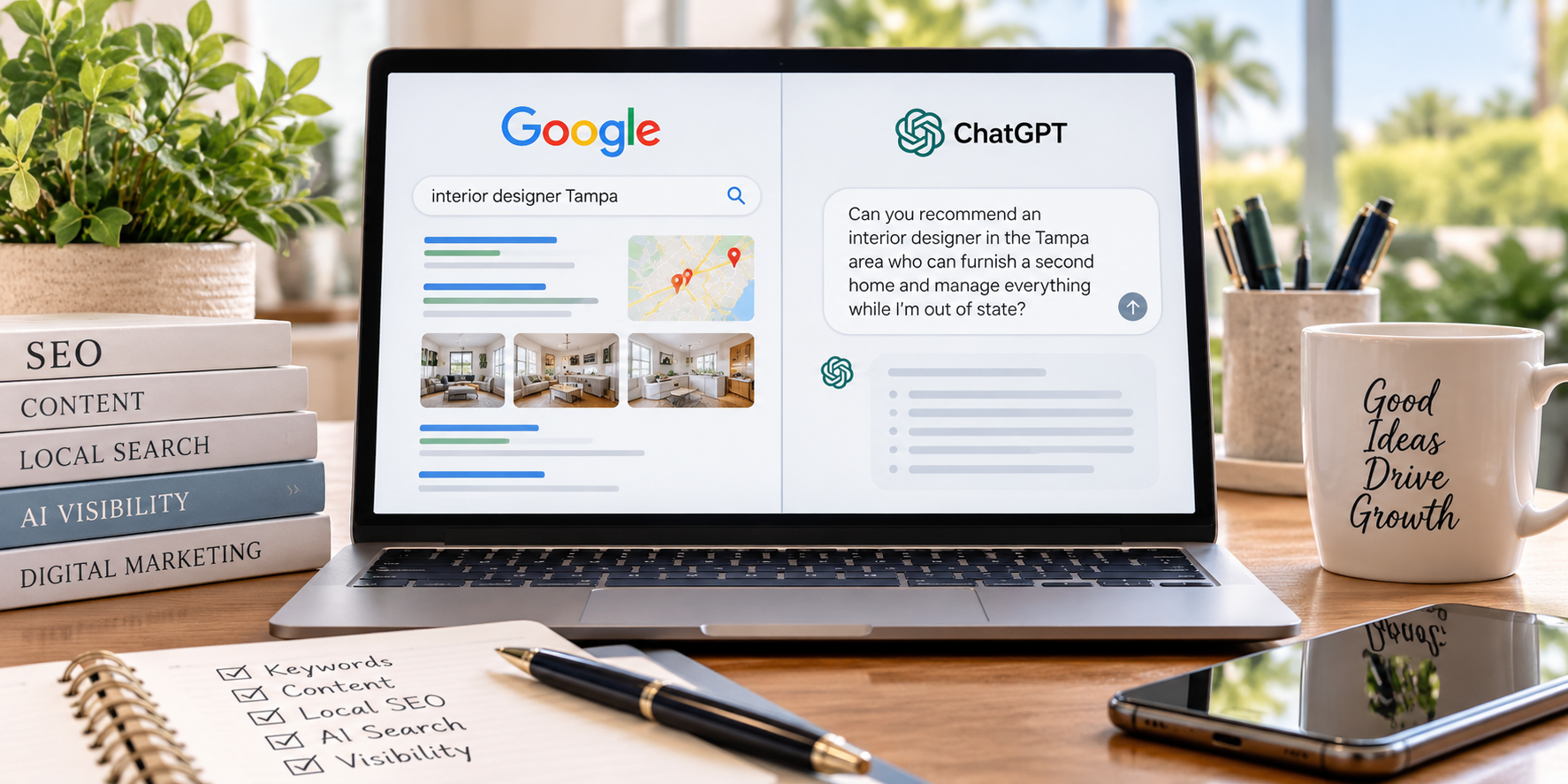
But today's search results may also include maps, local business listings, images, videos, featured information and AI-generated answers. And sometimes the search doesn't begin on Google at all.
People increasingly ask conversational AI tools detailed questions and expect useful answers rather than a page containing ten blue links.
Instead of searching:
interior designer Tampa
someone might ask:
“Can you recommend an interior designer in the Tampa area who can furnish an entire second home and manage everything while I'm out of state?”
That's a very different search.
And it's a much better indication of what that person actually wants.
We Are Moving From Keywords to Conversations
Keywords aren't disappearing.
They still help us understand what people are searching for, and they remain useful when planning website structure and content.
But search queries are becoming more conversational and more specific.
Someone looking for an accountant might ask about experience with a particular type of business. A homeowner might describe an entire remodeling problem. A business owner might ask which type of advertising would work best with a limited local budget.
This creates an opportunity for small businesses.
You may never compete nationally for an enormous, generic keyword. But you don't necessarily need to.
Your website can demonstrate that you are highly relevant to the specific problem a potential customer is trying to solve.
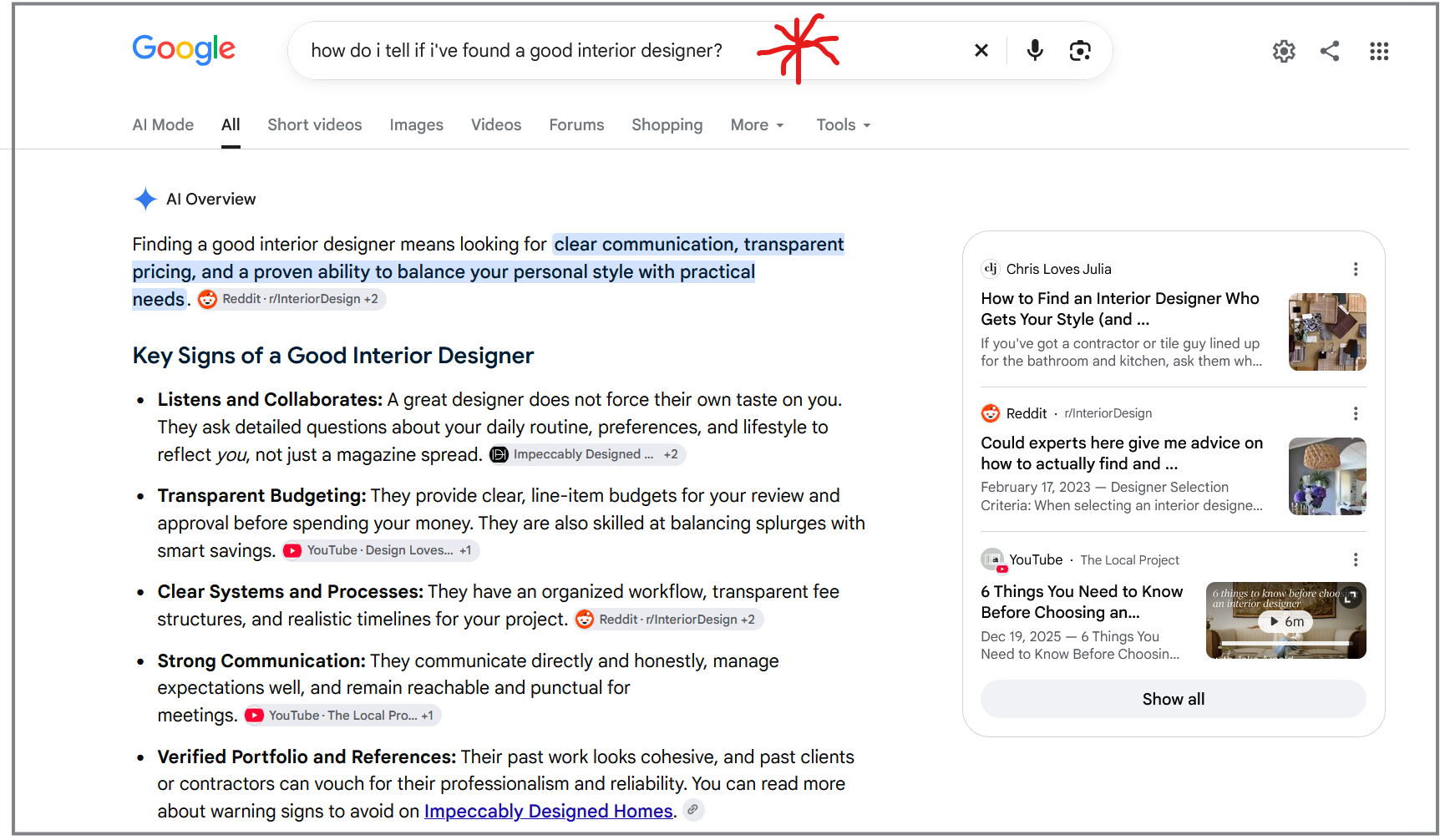
Instead of a search for an interior designer, people now want to know much more specific information.
AI Search Needs Information
This is one of the reasons I don't believe SEO and AI search should be treated as completely separate disciplines.
An AI platform needs information before it can understand a business.
Who are you?
What do you do?
Where do you work?
What are you particularly experienced in?
What questions can you answer?
What evidence exists online to support what you say about your business?
A website consisting of a beautiful home page and three sentences describing your services doesn't provide many answers.
That's why detailed service pages, About pages, FAQs, case studies, location information and genuinely useful articles have become increasingly valuable.
They help people understand your business.
They help search engines understand your business.
And they provide AI systems with clearer information about your business.
Being Found Doesn't Always Mean Getting a Click
This may be one of the biggest adjustments for business owners accustomed to measuring SEO by website traffic.
Traditionally, someone searched, saw your listing and clicked through to your website.
Today, some searches can be answered directly within the search experience.
That means a business may gain visibility without necessarily receiving a website visit every time its information contributes to an answer.
This doesn't make your website less important.
Quite the opposite.
Your website is one of the primary places where you control the information about your business. It establishes your services, experience, expertise, location and point of view.
But we may need to broaden how we think about success.
Visibility matters as well as clicks.
Good SEO Has Become Good Communication
There was a time when SEO had a deservedly questionable reputation.
Pages were stuffed with awkward keywords. Nearly identical location pages were created for dozens of cities. Articles were written primarily for search engines rather than people.
You can still find plenty of that online.
But the direction of travel is increasingly toward something much more sensible:
Create useful information for real people and make it easy for technology to understand.
That means clear headings. Logical website structure. Descriptive page titles. Useful service information. Original content. Accurate business details. Relevant internal links. Fast, mobile-friendly pages.
None of that sounds particularly mysterious.
And it shouldn't be.
Your Service Pages Matter More Than You May Think
One of the most common weaknesses I see on small-business websites is an attempt to put every service onto one page.
There may be six photographs, six headings and perhaps two sentences beneath each.
It looks tidy.
But it doesn't tell a potential customer very much.
If a service is important to your business, it often deserves its own page.
That gives you room to explain what the service involves, who it's for, how you approach it, answer common questions and demonstrate relevant experience.
It also gives search engines and AI platforms a much clearer understanding of what your company actually does.
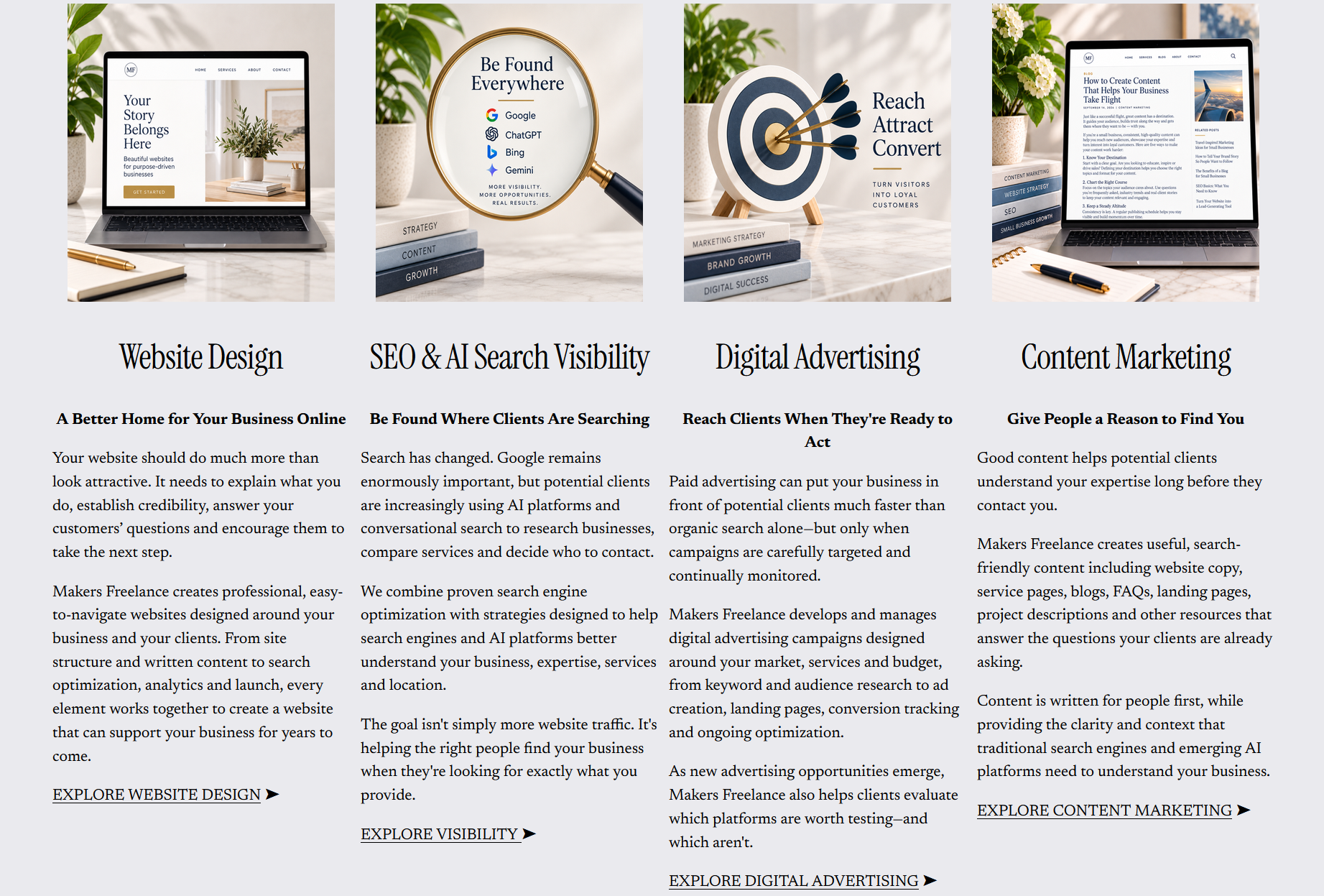
That's one reason I recently created separate pages for each of the four core services here at Makers Freelance rather than relying solely on four small descriptions on the home page.
Local Search Isn't Going Away
For many small businesses, geography remains enormously important.
A plumber in Philadelphia doesn't need an inquiry from Phoenix. An interior designer serving South Florida needs to be understood in the context of the communities they actually serve.
That means local SEO still matters.
Your website should clearly communicate your location and service areas. Your Google Business Profile should be accurate and maintained. Business information across the web should be consistent.
And where location pages are appropriate, they should contain genuinely useful local information, not the same generic paragraph with a different city name inserted into it.
AI hasn't made geography irrelevant.
If anything, detailed searches can make local relevance even more important.
Don't Abandon Google for AI
This is where I think small businesses need to be particularly careful.
The excitement surrounding AI can make it tempting to chase the newest thing and neglect what already works.
I wouldn't recommend that.
Google still matters. Your Google Business Profile matters. Traditional organic search matters. Your website matters. Paid search may matter.
AI search should become another consideration within your marketing strategy, not a reason to throw away everything that came before it.
The objective is broader visibility.
You want your business to be understandable and discoverable wherever your potential customers choose to look.
Can You Guarantee That AI Will Recommend My Business?
No.
And be cautious of anyone who says they can.
Just as nobody can legitimately guarantee you the number-one position on Google, nobody can guarantee that ChatGPT, Gemini or another AI platform will recommend a particular business for a particular question.
These systems are continually changing.
What we can do is strengthen the information and signals surrounding your business.
We can make your website clearer. Develop useful content. Establish expertise. Improve local information. Address technical SEO. Strengthen important service pages. Monitor visibility and adapt as the search environment changes.
That's not as exciting as promising a secret formula.
It's considerably more realistic.
SEO Isn't Dead. It's Growing Up.
I have worked in digital marketing since before Google became the dominant force it is today.
I've watched businesses move from printed marketing materials to websites, from directories to search engines, from desktop computers to mobile devices, and now from keyword searches toward increasingly conversational AI-assisted discovery.
Every major change has produced predictions that whatever came before it was finished.
Usually, it wasn't.
It evolved.
SEO is doing the same thing.
The businesses best positioned for this new search environment won't necessarily be those chasing every new tactic.
They'll be the businesses that provide clear, credible, useful information wherever their customers are looking for answers.
That sounds remarkably similar to good marketing.
Because ultimately, that's what it is.
Is Your Business Ready for the Way People Search Today?
If your SEO strategy hasn't changed in several years — or you're wondering whether AI search is affecting how people find your business — it may be time to take a fresh look at your online visibility.