
Is Your Business Showing Up in AI Search?
Reading time 8 minutes
For years, small-business owners have asked me some version of the same question:
“Where do I come up on Google?”
Now I'm increasingly hearing a different one:
“Can people find my business on ChatGPT?”
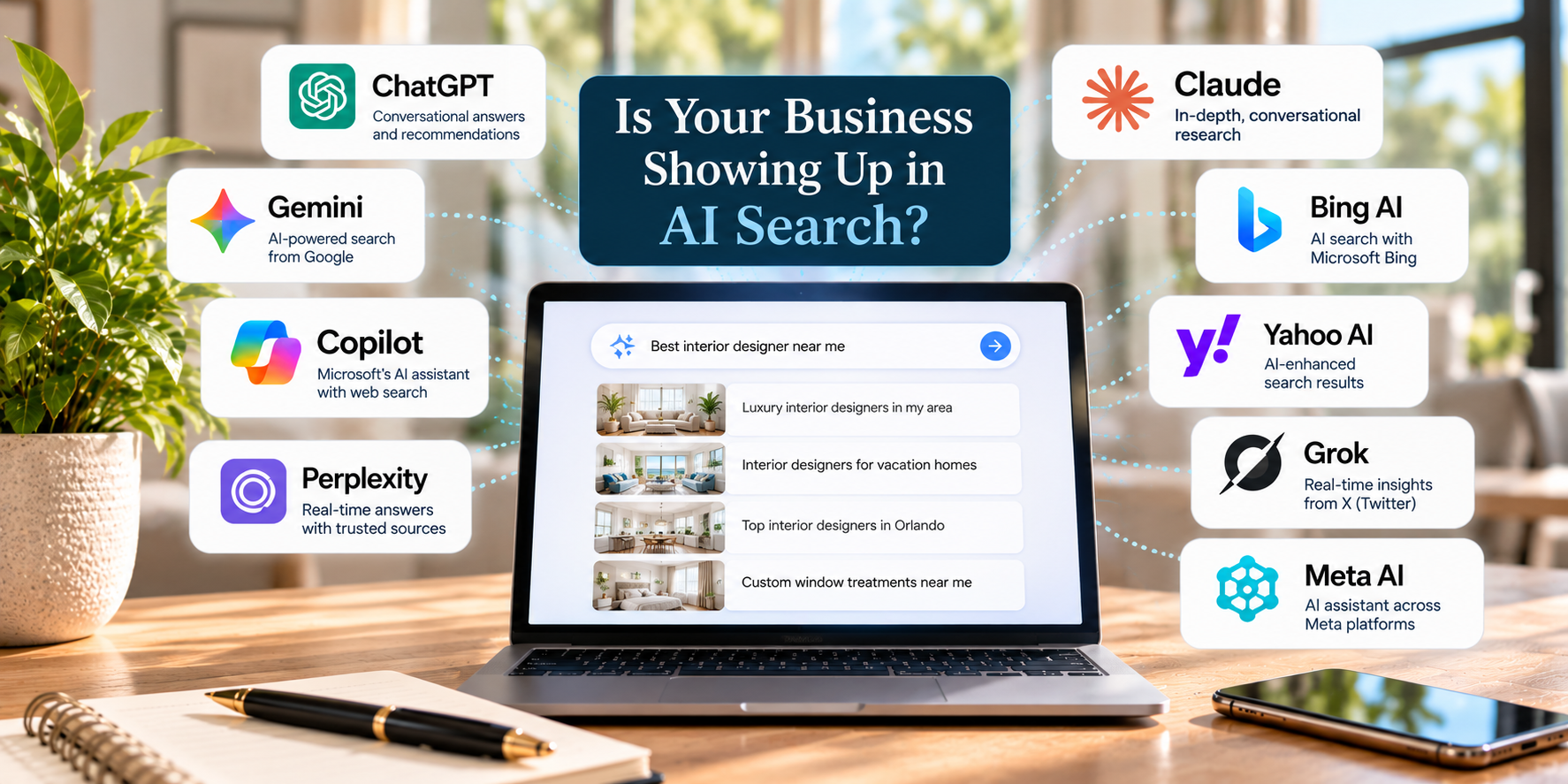
And it isn't just ChatGPT. Consumers are using AI-powered tools and AI-enhanced search experiences to research products and services, ask for recommendations, compare companies and get answers to increasingly detailed questions.
That means there's a new place where your business needs to be understood.
But how do you know whether AI can actually find you?
And, perhaps more importantly, what does it know about you when it does?
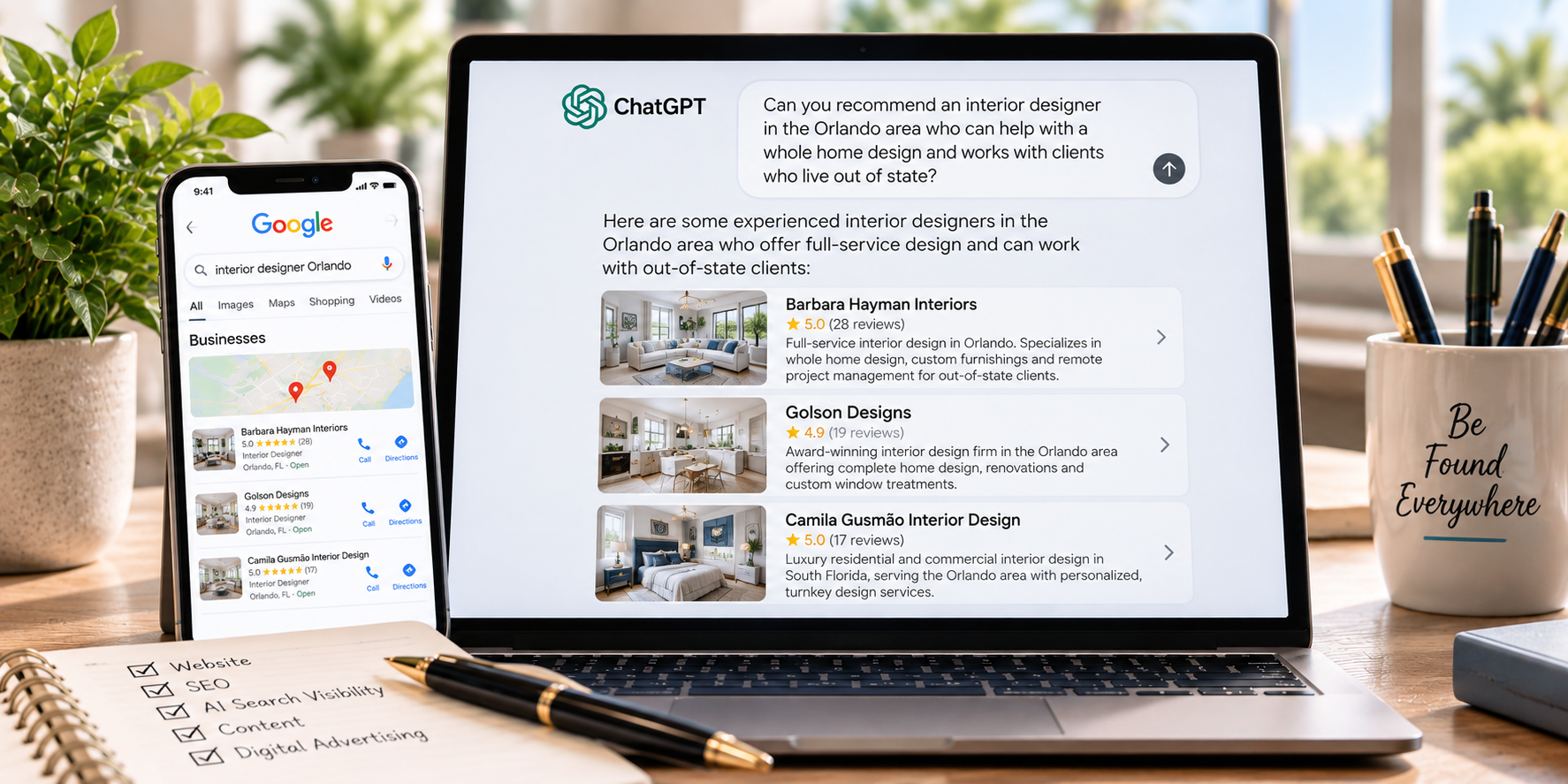
AI Search Is Different From a Google Search
Let's start with an important distinction.
Traditional search usually begins with keywords:
interior designer Orlando
accountant for small business
website designer near me
An AI search can be much more conversational:
“I'm furnishing a vacation home in Orlando but I live out of state. Can you suggest interior designers who could manage the entire project for me?”
Or:
“I'm looking for a local accountant who specializes in helping small businesses and can handle both bookkeeping and tax planning.”
The person isn't simply looking for a list of businesses.
They're describing a specific need and asking the technology to help identify suitable options.
For a business to have a chance of appearing in that type of response, the AI needs enough information to understand not only that the business exists, but also what it does and when it might be relevant.
Start by Searching for Your Own Business
The simplest test is exactly what you might expect.
Ask.
Open the AI platforms you use and search for your business by name.
Try questions such as:
“What can you tell me about [Business Name]?”
“What services does [Business Name] provide?”
“Where is [Business Name] located?”
“Who owns [Business Name]?”
“What is [Business Name] known for?”
Don't just look for whether the business appears.
Look at what the answer says.
Is the information accurate?
Does it describe your current services?
Does it identify the correct location?
Does it understand what differentiates your business?
Does it appear to be confusing you with another company with a similar name?
Sometimes what you discover can be quite revealing.
Then Stop Using Your Business Name
This is the more interesting test.
Someone who already knows your company name doesn't need much help discovering you.
The real question is whether your business has visibility when someone doesn't know you exist yet.
Think about the kinds of questions your ideal customer might ask.
Instead of:
“Tell me about Smith & Jones Interiors.”
try:
“Who are some interior designers serving Westchester County, New York?”
Then make the question more specific:
“Which interior designers in Westchester County specialize in custom furnishings and window treatments?”
Then more specific again:
“I'm looking for an experienced interior designer in Westchester County who can help with custom furniture, window treatments and a complete room redesign. Who should I consider?”
You can apply the same exercise to virtually any business.
The objective is to move from a brand search to the kind of detailed, problem-based question a prospective customer might genuinely ask.
Don't Test Just One Question
This is important.
One AI query isn't a definitive visibility test.
Change the wording.
Change the service.
Change the location.
Ask about a particular specialty.
Try several realistic questions that relate directly to the work you want more of.
You may discover that your business appears for one type of request but not another.
That's useful information.
It can reveal which aspects of your business are clearly represented online — and which ones may need more work.
Try More Than One AI Platform
Don't assume every AI platform will produce the same answer.
They won't necessarily have access to exactly the same information, interpret it in the same way or surface the same businesses.
If AI visibility matters to your marketing, test your business across several major search and AI experiences.
You may find that one understands your company very well while another has limited or outdated information.
Again, that doesn't necessarily mean something is wrong.
AI search is still developing rapidly.
What we're looking for are patterns and gaps.
What If AI Can't Find Your Business?
Don't panic.
And don't immediately start rewriting your website for robots.
Instead, look at your online presence from the outside.
If I visited your website knowing absolutely nothing about your company, could I quickly determine:
What you do?
Where you're located?
What geographic areas you serve?
Who you work with?
What your main services are?
What you specialize in?
Who owns or leads the business?
What experience or expertise you have?
How someone can contact you?
If those answers aren't obvious to a person, they're unlikely to be particularly obvious to technology either.
Your Website Needs Enough Information
This is where many attractive small-business websites run into trouble.
They simply don't say very much.
There may be a beautiful home page, an About page, a portfolio and a Contact page. But the services are described in a few sentences.
Specialties aren't explained.
Service areas aren't clearly identified.
There are no FAQs.
The blog hasn't been updated in four years.
Individual projects have photographs but no descriptions.
The website may look wonderful while providing surprisingly little information about the actual business.
For AI search — just as with traditional SEO — content matters.
Not content for the sake of having more words.
Useful, specific information that helps establish what your business knows and does.
Make Your Services Clear
If a service is important enough that you want customers to find you for it, consider whether it deserves its own page.
A dedicated service page gives you room to explain what you provide, who it's for, how you approach it and what makes your experience relevant.
Compare that with six services squeezed into six small boxes containing two sentences each.
Which version gives someone — or an AI system — a better understanding of the business?
That's one reason the Makers Freelance website has individual pages for Website Design, SEO & AI Search Visibility, Digital Advertising and Content Marketing.
I want each service to be clearly understood rather than merely mentioned.
Answer the Questions Your Customers Actually Ask
FAQs can be particularly useful because AI search is conversational by nature.
Think about what clients ask you during initial telephone calls and consultations.
How does the process work?
How far do you travel?
Do you offer a particular service?
How long does something take?
Who will I work with?
Do you work with businesses like mine?
These aren't merely SEO questions.
They're customer questions.
Answering them clearly makes your website more useful regardless of whether the visitor is a person, a search engine or an AI platform trying to understand your business.
Check Your Information Beyond Your Website
Your website isn't the only source of information about your company.
Depending on your business, information may also appear on your Google Business Profile, professional directories, industry websites, social platforms, review sites, news articles and other third-party sources.
Consistency matters.
If one source says you've moved, another lists an old phone number and your website describes services you stopped offering three years ago, you're creating unnecessary confusion.
Search engines have always benefited from consistent business information.
The same principle remains useful in an AI-driven search environment.
Reviews Help Tell the Story Too
Reviews provide something your own website cannot: other people's descriptions of their experience with your business.
A detailed review might mention a particular service, location, project type or problem you solved.
That's useful context.
Encourage genuine customers to leave genuine reviews. Don't tell everyone to use identical wording and don't manufacture reviews to create particular keywords.
The value comes from real people describing real experiences.

Keep Building Evidence of Your Expertise
One of the most effective ways to strengthen your online presence is also one of the least mysterious:
Demonstrate what you know.
Write useful articles.
Develop case studies.
Explain your services properly.
Describe successful projects.
Answer questions.
Keep important information current.
If you've been in business for 20 years, your website should provide some evidence of that experience.
If you're particularly knowledgeable about a specialized service, explain it.
Don't expect technology to somehow know what you've never told it.
Can You Optimize Specifically for ChatGPT?
This is where I'd be wary of anyone selling a guaranteed formula.
AI search is evolving quickly, and there isn't a magic collection of keywords that guarantees your business will be recommended by ChatGPT or any other AI platform.
Nor should you completely redesign your marketing every time a new technology appears.
The sensible approach is much less dramatic:
Build a strong online presence that clearly establishes who you are, what you do, where you work and what you know.
That's good for customers.
It's good for traditional search.
And it gives AI systems better information from which to understand your business.
Measure AI Visibility — But Keep It in Perspective
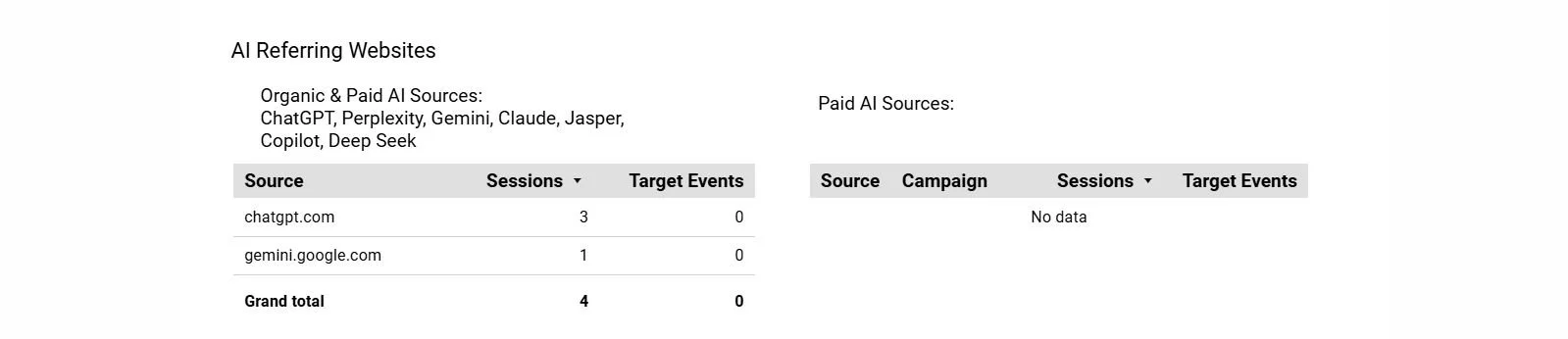
Tools are beginning to emerge that monitor how brands appear across AI search platforms.
They can be useful for identifying changes, comparing prompts and spotting areas where a business has little visibility.
But AI visibility is still a developing measurement discipline.
Don't become obsessed with a single score.
And don't assume that appearing in one AI answer today guarantees you'll appear in exactly the same answer tomorrow.
Use the information to identify opportunities and guide your strategy — not as a reason to chase every fluctuation.
AI Search Doesn't Replace Everything That Came Before It
This may be the most important point.
You still need a good website.
You still need SEO.
For a local business, you still need a well-maintained Google Business Profile.
Reviews still matter.
Useful content still matters.
Digital advertising may still be an important source of leads.
AI search is another way people are discovering and evaluating businesses.
The objective isn't to abandon traditional marketing in pursuit of the newest technology.
It's to make sure your business can be found and understood wherever your customers choose to search.
Try the Test Yourself
Take ten minutes today and search for your own business.
First, search by name.
Then pretend you've never heard of your company.
Ask several AI platforms the kinds of questions your ideal customer might ask when looking for the services you provide.
Look at what comes back.
You may be pleasantly surprised.
You may discover outdated information.
You may find competitors you weren't expecting.
Or you may discover that your business is barely visible at all.
Whatever the result, you've learned something useful.
Because before you can improve your AI search visibility, you need to know what AI currently sees.
Wondering How Visible Your Business Is in AI Search?
If you're curious about what AI platforms understand about your business — and whether your website is giving them enough useful information — Makers Freelance can help you take a closer look.